Wednesday, March 5, 2025

20250305 Wednesday, March 5, 2025 Hot Air Balloon ride over Western Thebes, Nile River Cruising to Qena

20250305 Wednesday, March 5, 2025 Hot Air Balloon ride over Western Thebes, Nile River Cruising to Qena, Dandarah Temple of Hathor, Cruising back to Luxor

Although we have been getting up spontaneously between 3-4:30am because of our jet lag, when you have to get up for a specific reason, it seems harder to convince ourselves to actually pop up out of bed and get dressed.  We’re were in the lobby at 4:15am for coffee and pastries before being bundled into the buses to do our hot air balloon ride on the West Bank of the Nile.  The bus took us to a water taxi pier where we all got shuttled over to the West Bank of the Nile.  There, we got further divided up into minivans which then drove us to a large field in the dark.  

We had no idea what to expect but from out of nowhere, children could be seen through the minivan windows with trinkets to sell or birds to take pictures with.  These kids had to get up before sunrise to try to make a little money before school, apparently.  As the sun rose, we could begin to see that there were dozens of balloons laid out around this very large open area, and dozens of minivans full of tourists who were going for balloon rides.  


We had to wait a long time for authorities to signal that it was safe to go aloft.  They initially sent a pair of helium balloons aloft and we curiously watched them first float to the west, and then turn around and head back eastward overhead.  Then all of a sudden, all the balloon handlers sprung into action, firing up really loud gas powered fans to begin inflating the balloons.  Once they began to fill up, they would shoot huge gas flames into the balloons.  The baskets attached to the balloons were each about the same size as the minivans we arrived in, and were laying on their sides.  Once the balloons started to transition from horizontal to vertical, this pulled the baskets upright and a dozen or so balloon handlers then manned tethered lines and assisted passengers into the baskets.  


The baskets were divided up into compartments that were about 45” square, and into each basket, they had 3 passengers climb in.  It was tight but not uncomfortable.  In total, each balloon carried 24 passengers aloft. Janet and Ben ended up in compartments on opposite sides of the balloon, but this allowed us to see out of both sides of the balloon basket.  


The balloon handler sat in a central compartment surrounded by huge propane gas cylinders and 4 large overhead burners that created the hot air for lift.  The flames from these burners shoot 6-10’ high into the balloons.  When the burners are fired up, we really appreciated the fact that there was a sheet of metal above our heads so our hair wouldn’t get singed.  The roar of the flames is really something to be experienced.  


The sensation of lifting in the balloons is quite gentle and it was fascinating to see how the balloon operators had figured out the air currents in this area allowed them to basically circle around several temples on the West Bank of the Nile including the Ramesseum, which is a ruin which is being actively excavated, and the highly recognizable temple of Hatshepsut at the foot of the mountains that form the Valley of the Kings.  We didn’t actually fly over the Valley of the Kings or get high enough to see into it, but mostly hovered and circled around the complex of temples between the Nile and the Valley of the kings.  


When the balloons gain elevation, the balloons drift to the west and south, but when they descend, they head east and north, so it is possible to drive the balloons with some precision.  In addition, the balloonist can open some panels in the dome of the balloon to vent hot air and spin the balloon around.  The views of the tombs below were unique, and it was quite an experience seeing all these balloons doing their aerial ballet.  


At the end of the ride, the balloonist was able to put the balloon down right where his ground crew was waiting.  There were long tether lines that the ground crews grabbed and used to control the ballon in the final 20’ or so of its descent, and the landing was extremely gentle and controlled.  It was nice not to have our basket tip over and have us dragged through a field of cows or power lines. 


Heading back to the ship, we ended up transferring from the minivans to another water taxi which took us back across the river an deposited us right behind our ship.  That supposedly saved about 2 hours that it would have taken to drive the minivans across the nearest cross Nile bridge to get back to the ship.


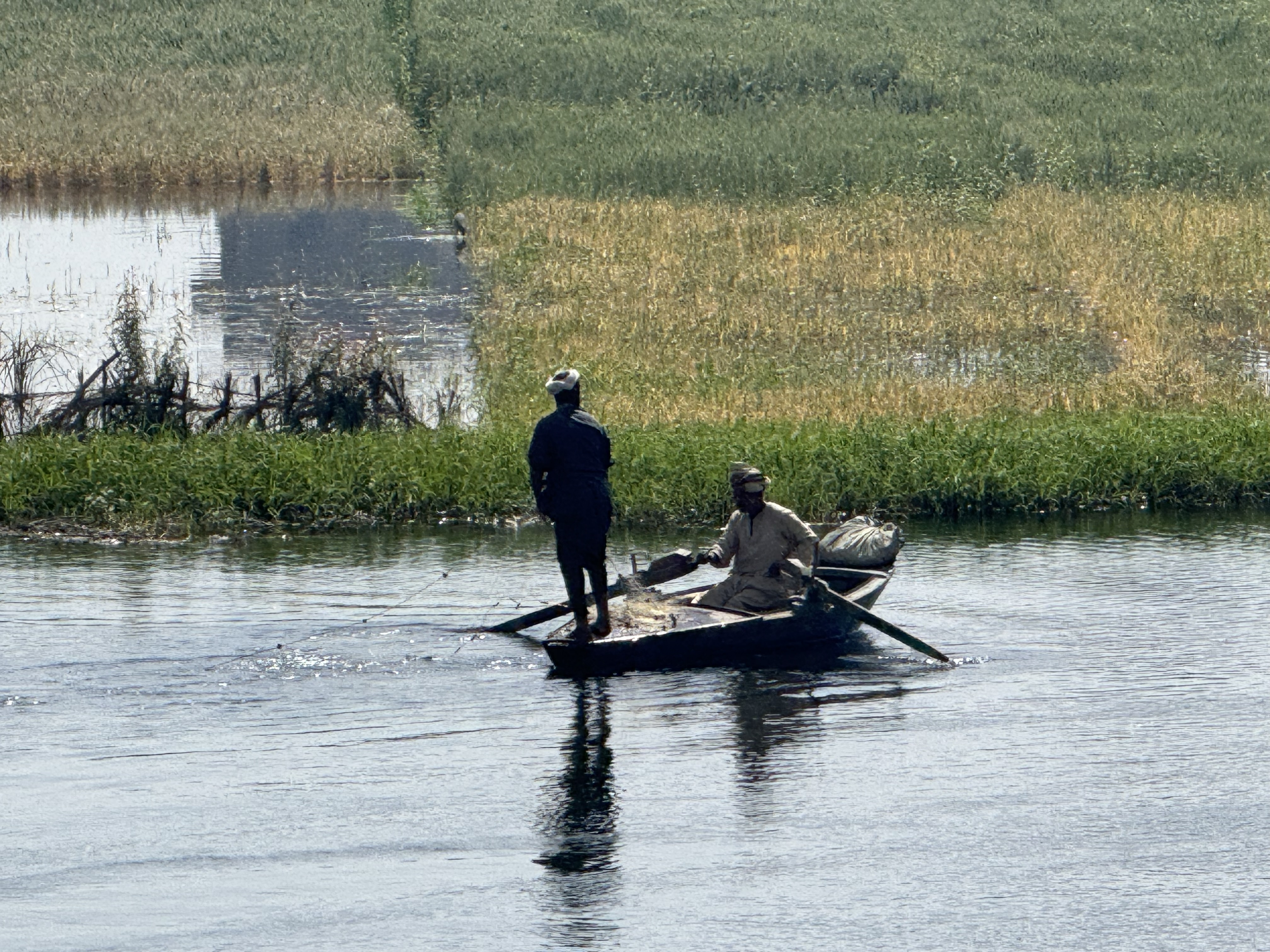
We had breakfast in the Aquavit terrace, which is topside and aft on the ship as it pushed off from shore and then began sailing downstream from Luxor to Qena.  The Nile sailing was very pleasant.  The outside temperature as in the mid to upper 70’s and it wasn’t too windy so you could very comfortably relax on the outdoor upper deck and enjoy the scenes. There are areas were it appears that locals in very small row boats ferry people across the river.  Surprisingly there are also small herds of cattle, donkeys and horses that seem to be feeding on tiny sand bars and islands along the periphery of the Nile. We saw a couple of people doing their laundry in the river, and also saw men fishing from small row boats using nets.  


At 10:30am there was a lecture by Minal on some of the geography and history of the Nile River.  Since we had been up since before 4am, it was a bit of a struggle to stay awake for the entire lecture, but we were rewarded with some downtime afterwards to nap until lunch.  


When we awoke from our nap, we noticed that the ship was nearly at a standstill with no noticeable wake outside our window.  When we went up to lunch, we discovered that the ship had already docked alongside another ship, an Amawater Ways Nile River cruise ship.  This had obstructed any sort of view out the port side of the ship, so we were fortunate to have been on the starboard side.  

Lunch featured a tasty carrot ginger soup starter.  Ben opted for a good ole fashioned cheeseburger but with avocado added.  It also came garnished with lettuce and caramelized onions.  Janet opted for chicken shawarma in a pita with fries.  Dessert was something called Egyptian corn flake ice cream.  This turned out to be vanilla ice cream served with what can best be described as corn flakes coated with almond bark.  It had an interesting texture and tasted good, although not quite like Tony the Tiger’s Sugar Frosted Flakes.

While we were eating lunch, the boats at the landing played musical chairs and we got repositioned directly on the landing with no other ship on our beam any longer.

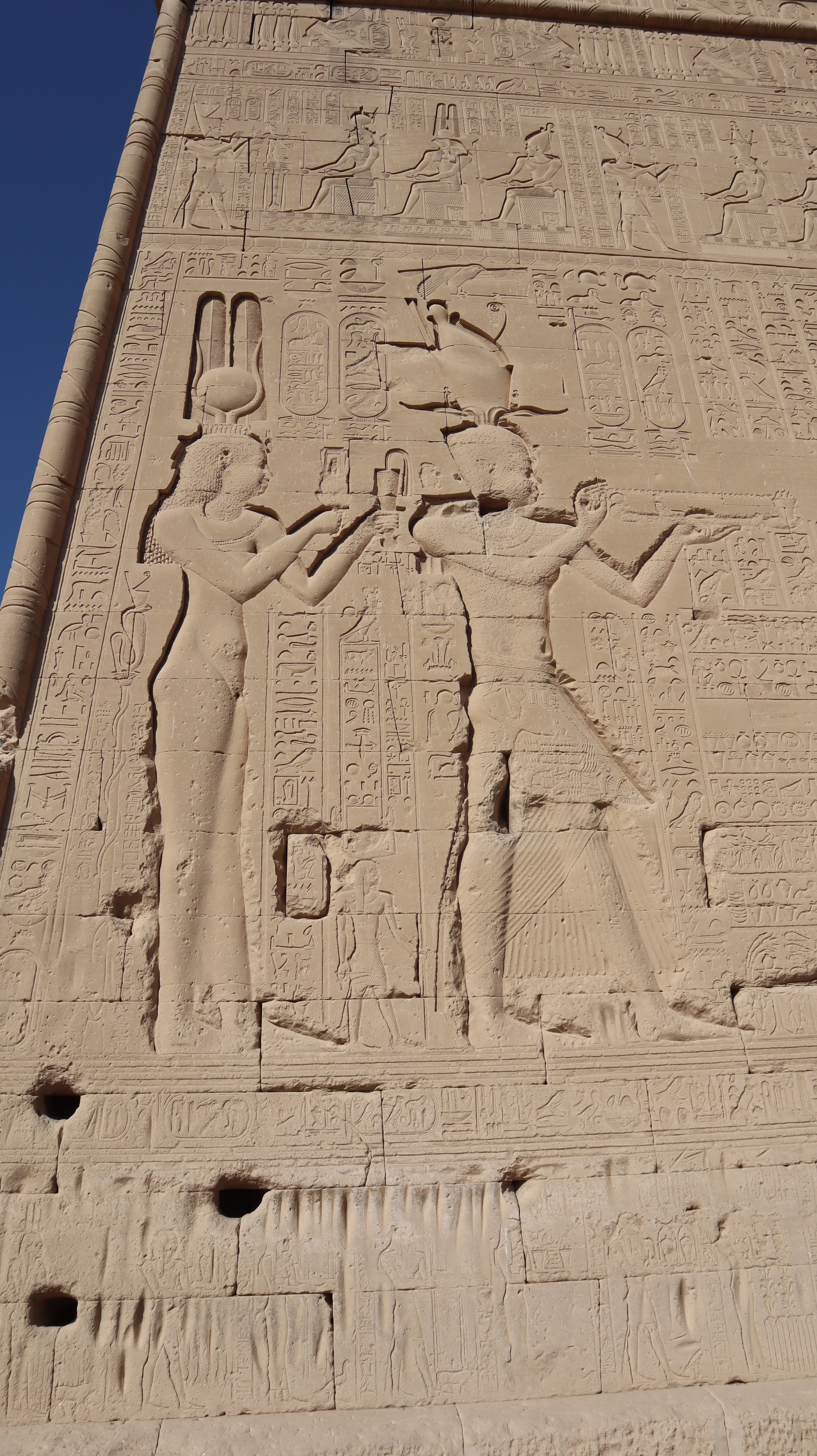
After lunch, we barely had time to grab out excursion kit and head off the ship for a tour of the Dandarah Temple in Qena.  This is a temple dedicated to the Egyptian goddess Hathor.  In the temple there are depictions of several interesting things including the symbols of the Zodiac.  This temple was erected in the latter years of the period of the Pharaohs after Alexander the Great had conquered Egypt and declared himself to be Pharaoh.  On the back side of the temple is a large carving depicting Cleopatra VII, who reined as the last Pharaoh of Egypt.  She is depicted as a Pharaoh while Julius Caesar is depicted as a god.  

This temple has some remarkable colorful artwork on the ceiling. This had been hidden for centuries until someone decided to clean off the layers of soot and uncovered what we now see.  There are references to astronomy including phases of the moon, a calendar, and the symbols of the Zodiac.  

Goddess Nut of the sky on the ceiling about to swallow the sun.

Hathor, namesake of our ship

Dendera hypostyle hall and ceilings

There is a staircase leading up to the roof of the temple where a small crypt houses hieroglyphs depicting the story of Osiris being murdered by Seth and dismembered into 14 parts.  Isis, his wife, took it upon herself to reassemble him and mummify him properly.  Unfortunately, she could only recover 13 of the 14 pieces.  That missing piece could best be described as his manhood.  So she crafted a prosthesis of clay to finish the reconstructed mummy.  She then descended upon him in the form of a falcon, landing on his prosthesis to conceive Horus.  Who knew there was so much smut in Egyptian mythology.  But then again, the Greeks weren’t any less obscene.  


Vultures and Cobra Sun Disks on the ceiling

Evidence of Advanced Alien technology, or lotus flower?

Osiris’ reconstruction

Isis in the form of a falcon achieving immaculate conception of Horus

After returning to the ship, we cruised back upstream to Luxor.  Ben checked out the “pool”, which is really just a bench you can sit on in the water, which is just knee deep. But it would be nicely cooling and it was very pleasant to sit there and look out beyond the infinity edge of the pool at the boat’s wake and Nile valley as we motored back upstream.


We got to watch some in room TV which included videos on more details of the various temples and Pharaohs, as well as nap before the evening’s daily briefing.
The ship’s officers and Egyptologists were introduced with a champagne toast at the daily briefing. 


Tomorrow will be a long and strenuous day to visit the Valley of the Kings.  We will be visiting the Mortuary Temple of Hatshepsut, which we saw from the hot air balloon ride today, as well as the tombs of King Tut, SETI I and the Howard Carter House.  But at least we won’t have to get up at 4am.


Tuesday, March 4, 2025

20250304 Tuesday, March 4, 2025. Cairo to Luxor Flight. The Temples of Karnak and Luxor. Welcome to the Viking Hathor

20250304 Tuesday, March 4, 2025. Cairo to Luxor Flight.  The Temples of Karnak and Luxor.  Welcome to the Viking Hathor

Getting up in time to finish packing and getting checked out by 5:15am was easy since in our jet lagged state, we normally wake up around 4am.  Now we just have to convince ourselves to really make a go of it.  

The hotel transfer and flight from Cairo to Luxor was made pretty simple thanks to our Viking handlers preparing us for each step in advance, and watching over us like a mother duck over her ducklings.  The security at Cairo’s airport is pretty intense, even for domestic flights.  You are allowed to bring water bottles, but we went through 3 separate screenings and got patted down at each level.  It was notable that they had separate security lines for men and women so that the women could be screened by female agents.  But like at the ballpark, the line for the women’s screening was a lot longer and slower than the men’s.  

The flight from Cairo to Luxor was on a Bombardier regional jet, not unlike the one that a few weeks ago lost a wing on landing and flipped over upside down.  Blazed on the fuselage was Petroleum Air Services, so this appears to be a charter flight service.  The plane was all single class and tightly packed, but it was only an hour’s flight.  We did not see the Giza pyramids on our flight south but the green strip of the Nile’s fertile valley is quite the contrast to the surrounding brown desert and mountains.  

The only hitch on the transfer was while we were waiting to claim our luggage, Ben stepped outside to take a picture of a large LUXOR sculpture in front of the terminal.  Unfortunately, when he turned around to go back in, it turned out to be a one way trip, and no admission back into the baggage claim was allowed.  


Ben did get Janet’s attention who grabbed Fatma to see if she could rectify the situation.  She simply and calmly said please enjoy the sunshine outside.  We will be joining you just as soon as the baggage comes out.  Janet just had to mark our bags by raising the pull handles and everyone was soon heading out the same door to the familiar looking Viking tour coaches.

These were different buses and drivers from what we had in Cairo.  These buses were a bit smaller so there were fewer empty seats, but comfortable and modern.  
The bus took us from the airport directly to Karnak Temple where Fatma gave us a highly informative and insightful tour, pointing out several key carvings and relating their symbolic and historical significance, as well as how the Karnak Temple evolved over the millennia under different rulers and economic periods.  


As impressive as the Temple is at present, it was notable that for thousands of years, the bottom 30 or so feet were buried in the sand so the main entrance to a Mosque that was built into the structure in the past is now over 30’ up in the air.  


Opet was one of the most important ceremonies that took place during the period of the Pharaohs. This involved transporting ceremonial boats transporting statues of 3 gods between Karnak and Luxor.  These were Amun, Mut and Khonsu.  The pharaoh at the time caused a bit of a stir because he attempted to change Egyptians, who worshipped a plethora of local gods, into worshiping only Amun Ra, the god of the sun.  Mut was a vulture headed wife to Amun and mother figure.  Khonsu was their son and the embodiment of the light of the crescent moon.  At arrival to the Luxor Temple, Amun is magically transformed into Min, the god of fertility, whose manhood is depicted as the exact opposite of Min (try Max instead).


Carvings in the temple depict the boats bearing the gods on the shoulders of many men, rather than floating down a river.  These figures include high priests, as indicated by the robes they are depicted in, as well as many characters in masks.  One might argue the Carnivals celebrated in western cultures, like Mardi Gras or the famous Carnivals of Venice and Rio, were descendants of Opet. 


Interestingly enough, one of the first structures inside the Karnak Temple is basically a boat house for housing the three ceremonial vessels.  Running between Karnak and Luxor is a 3km long avenue lined with sphinxes.  


The scale of the Karnak Temple is hard to imagine. The most impressive feature is the central Great Hypostyle Hall,  which is a Forest of intricately carved and painted columns.  Although the paint has faded over the millennia it is remarkable to see that it survived at all being sand blasted for thousands of years.  These columns predate the Greek and Roman ones by thousands of years.  


There are numerous obelisks scattered around the site, many temples, and even an artificial lake.  During the time of the Pharaohs, the site was surrounded by a wall and covered 200 acres.  This is larger than the sprawling main temple of Angkor Wat in Cambodia.  


We have been fortunate to have ideal weather conditions so far during this trip.  It has been sunny with high cloud cover or clear skies. The temperatures start off in the upper 50’s and have been maxing out in the mid 70’s.  Winds have been gentle.  It has been very comfortable in shirt sleeves.  A light fleece is all that is necessary before 8am and after 8pm.

After Karnak, we visited the Luxor library where we watched a movie highlighting Luxor’s, formerly Thebes, landmarks.  For many it was a chance to rest our eyes for a bit.  The Library has the Avenue of Sphinxes right behind it.


At lunch time, we got to board the Viking Hathor for the first time.  It is tied up very close to the library, and all by itself.  There were no other ships tied up alongside, like we have seen with the Viking River cruise ships on the Danube in Vienna.  
The ship is beautiful and pretty much brand new.  It is a new design specific to the Nile.  We have the most basic stateroom, which was also the last one available on this sailing.  The stateroom turns out to be quite large and comfortable.  It does not have a Veranda, but does have a nice sized window at a comfortable height so you can rest your elbows on the sill.  


There is a tremendous amount of storage in the room with 20 pull out drawers, 9 shelves, and about 5’ of closet rod.  The desk is about 24” deep and at least 5’ wide, so a real desk.  The bathroom is pretty much identical to the expedition and ocean cruise ships with heated floors and mirrors.  


There is a comfortable love seat sized sofa and coffee table, and there is plenty of room to be able to maneuver round these even when someone is seated at the desk.  

One thing unique for Egypt is there is a hand sprayer bidet next to the toilet.  One reason toilet paper is so hard to come by in Egypt is that most Egyptians use these hand sprayer bidets instead of toilet paper.  They are not nearly as refined as the Japanese high tech bidets, but they can get the job done.  Ben later discovered that if you see a knob on the side of the toilet bowl, that is also for a hidden bidet spray under the rim.  Don't open that knob to see what it does with the toilet lid up or you'll be in for a big wet surprise.  


Other parts of the ship are very much like the River and Expedition ships except that there is no spa at all and no DIY guest launderette.  The only option for laundry is formal laundry service where a pair of socks costs 100 EGP or $2 US.  Looks like we’ll be doing some socks and underwear in the sink.  

There is a dining room for all meals with a single seating like on the River cruise ships.  There is an Aquavit open air dining area and a very small sitting pool where you can sit partially in the water and squat if you want to get more wet.  You can’t really swim in it though.  There is a bar in the briefing room which is like the living room area on other ships.  This again is very much like the European Viking Longships design.  


The lunch was the first really decent meal we have had on this trip.  The Sofitel hotel’s restaurant was a disappointment.  Janet and Ben both had English style Fish and Chips with mushy peas, followed by Mango ice cream for dessert.  


The included drink service includes house wine and beer with lunch and dinner, but the house wines only include Egyptian wines, and there are only 3 beers on board- An Egyptian lager, Stella and Heineken.  The Egyptian lager was pretty unremarkable but drinkable enough.  The Egyptian wines, on the other hand were not very good. Perhaps we are just West Coast, New Zealand and Argentina wine snobs.  

After lunch, everybody got their suitcases unpacked and there was a brief, but chaotic muster station drill.  They told every one they had to go to their cabins and await instructions, but the instructions never came over the overhead speakers.  Instead, people just stuck their heads out into the halls wondering what we were supposed to do.  Eventually, crew members told everyone to grab the life jackets from under the beds and to go to the muster stations specified on the back of the stateroom doors.  For the most part, everyone just gathered in the central lobby one floor up from where your room was. We then had to don the life jackets, and then return to our rooms.  There was no seven short blasts of the ship’s horn followed by one long blast.  Princess has their muster procedures as well as accounting for passengers going ashore much better refined.  

On this ship, when you leave the ship, you have to see someone at the passenger services to get a laminated card with your name and room number on it.  This is your boarding passport.  When you return, you have to return it to passenger services. There is no scanning off or onto the ship.  

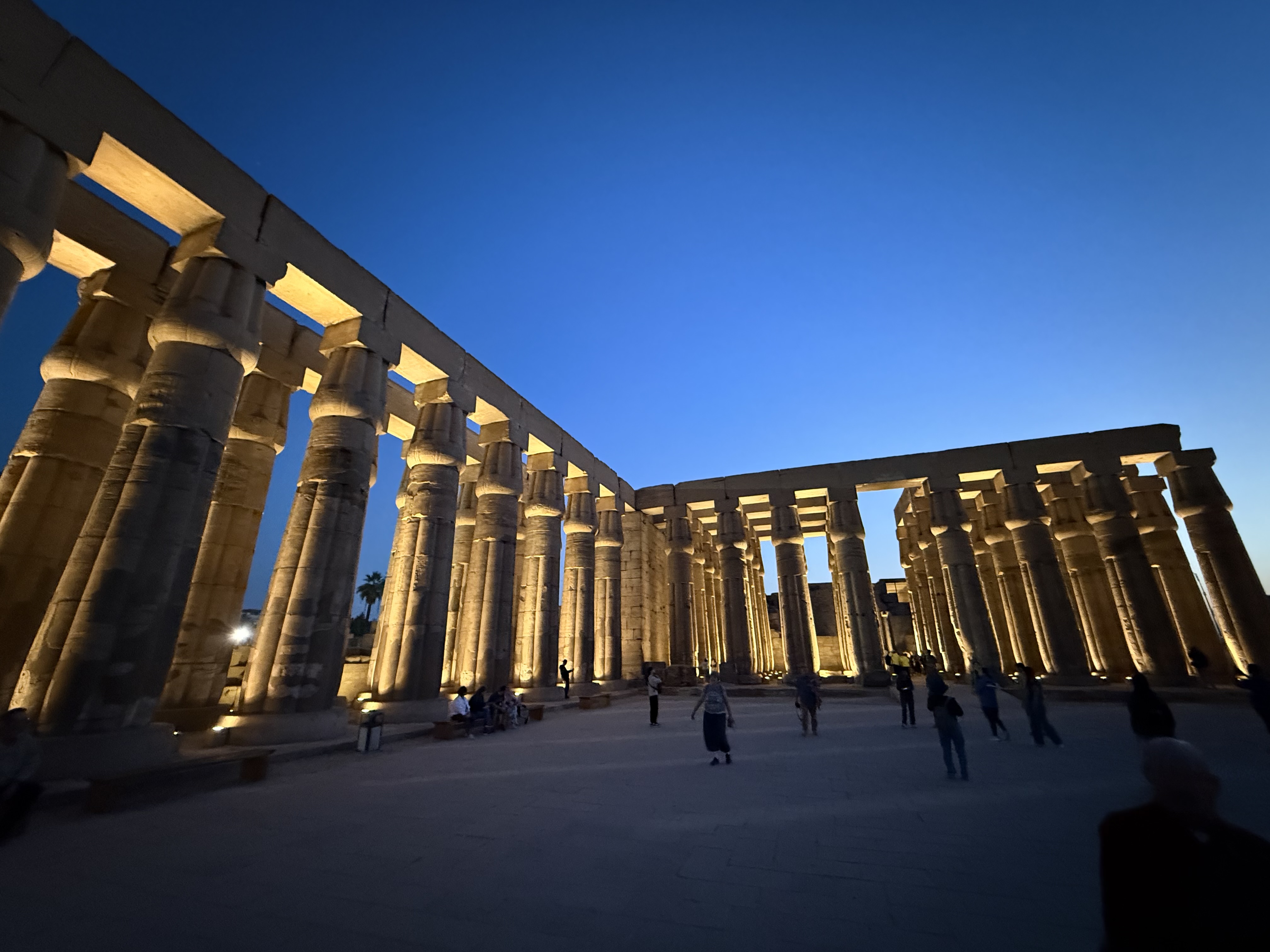
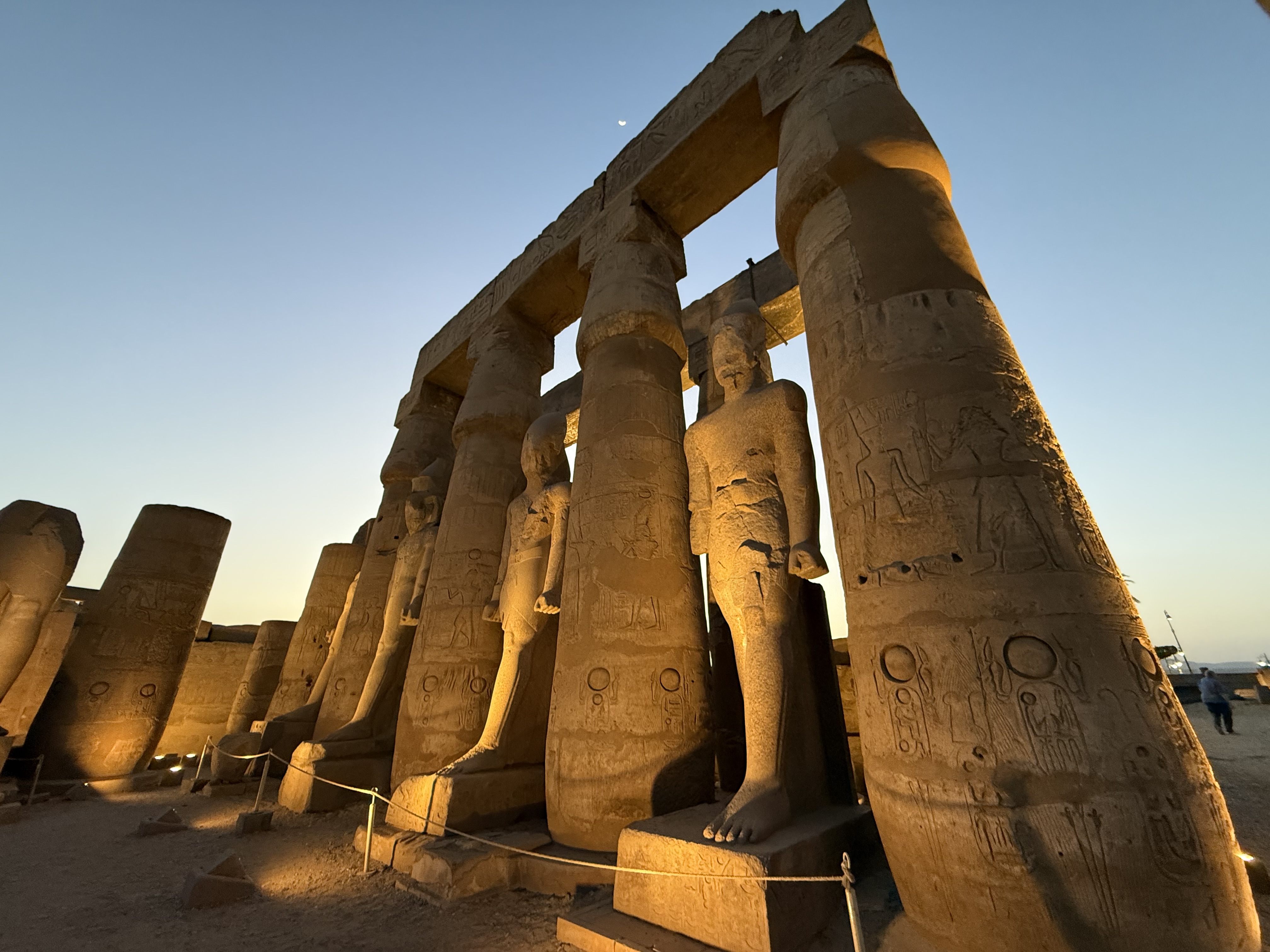
Once that was done, we got back ashore and into the buses to visit the Luxor Temple just before sunset.  We got to witness the temple’s transformation from daytime to night time, and to add to the effect, there was a beautiful crescent moon overhead during Ramadan.  


The Luxor temple is smaller than Karnak, but no less elegant, and still a huge structure.  It may be almost as famous for what’s not there as what is there.  There once stood a pair of beautiful obelisks in front of Luxor temple.  Now one resides in Paris.  


There is a smaller forest of columns at Luxor, but some of these take the shape of flower buds rather than bundles of reeds.  What is more interesting is evidence of the Greek and Roman influences over the history of the site.  The Romans covered some walls with plaster and frescos, concealing the hieroglyphics and carvings below.  Alexander the Great went so far as to present himself as a Pharaoh and having his cartouche carved inside the most sacred part of the temple.  

Can you spot the fertility god?

Crescent Moon

Fresco


We wrapped up the night with dinner on the ship.  Janet had veal while Ben got to try Egyptian Nile Perch, which was excellent.  It’s hard to emphasize how much better the food on the ship is compared to all our prior meals during this trip.
Tomorrow we have to get up 3:45am so we can take a hot air balloon ride over the Valley of the Kings as the sun rises over the horizon.  There certainly has not been any real downtime during this extremely busy tour so far.