Monday, March 3, 2025

20250303 Monday, March 3, 2025. The Pyramids and the Sphinx

20250303 Monday, March 3, 2025. The Pyramids and the Sphinx

We pretty much fell asleep as soon as we got back from the market and restaurant last night, but still are popping up awake at about 4am.  This may work to our advantage since we will have to get up at 4am to do the hot air balloon ride over the Valley of the Kings, and tomorrow we check out of the hotel at 6am and have to have our luggage out by 5:15am.  This morning we had time to do our Duolingo lessons while on the hotel’s WiFi before heading down for breakfast at 6:30am.
  
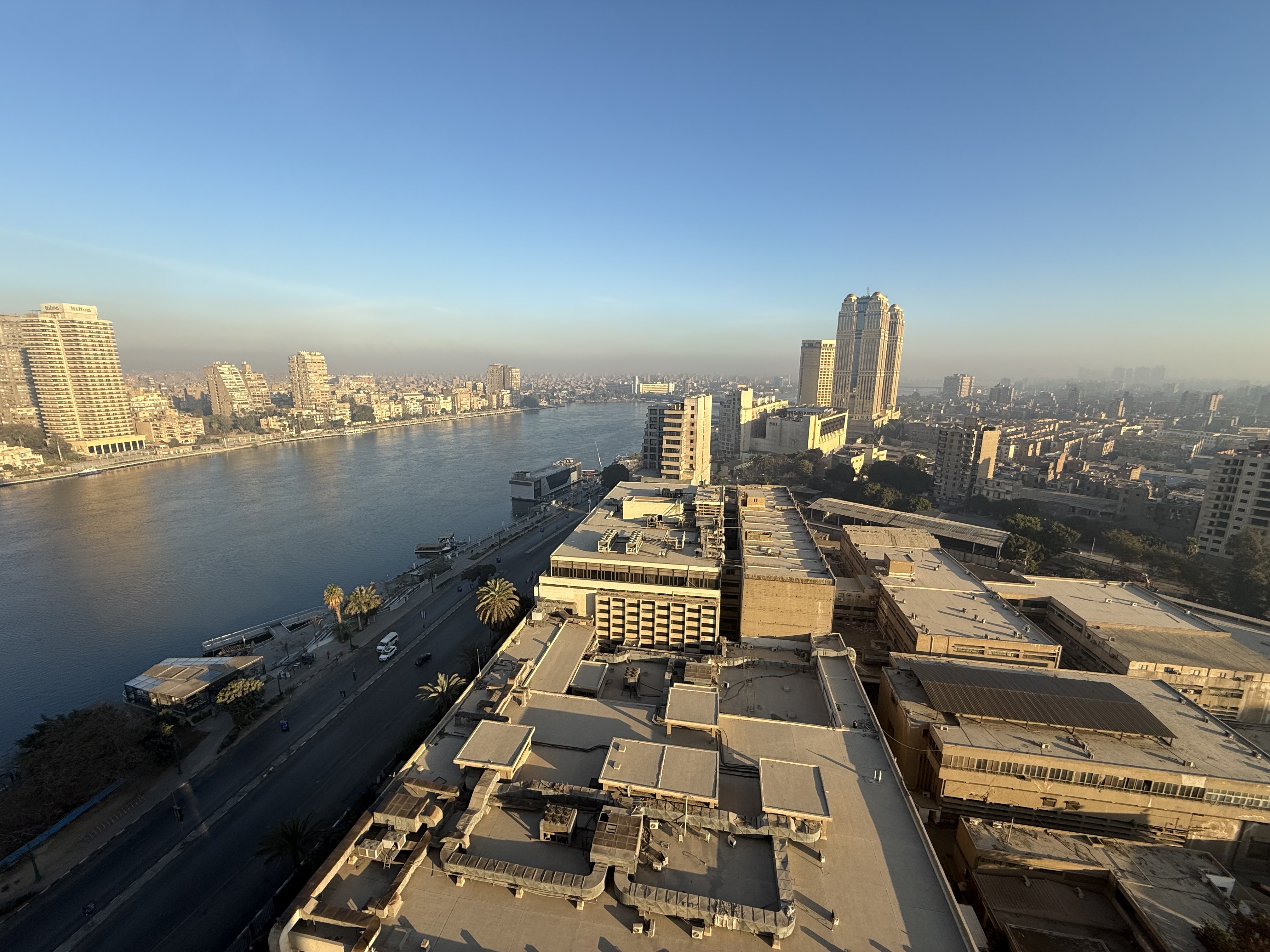
The hotel is on the east bank of the Nile. It is considered preferable to live on the east side of the river where the sun rises every morning as a symbol of rebirth.  Today we travel across the Nile to the West Bank, where the sun disappears every evening.  The ancient Egyptians believed the sun took a trip through the underworld, the same journey human souls have to follow when they die.  Our first stop today was the Djoser Step Pyramid of Saqqara.  This is the first pyramid in Egypt and was erected in the 27th century BC for the burial of the third Egyptian dynasty pharaoh Djoser.  Prior pharaohs were buried further north in Abydos.

Ancient Memphis Necropolis

The step pyramid is actually situated in the middle of a vast necropolis, which served the ancient capital of Memphis.  New tombs are being excavated every day.  We descended into one of these tombs through a narrow and steep passage.  It was angled at nearly 30˚ while the passage was less than 5’ square so it was not possible to stand.  


Descending into the tomb required duck walking down the steep ramp, which was lined with a plywood floor onto which ladder like rungs were situated about every 2 feet.  This was quite strenuous and awkward.  However, once reaching the actual tomb chambers deep underground, the chambers have walls about 8’ high and a cathedral ceiling.  Some of the ceilings are decorated with carved stars that look like starfish.  The walls were carved with heiroglyphs.  There is a large empty stone sarcophagus in the main chamber, and a smaller chamber that probably housed burial goods.  


A nearby excavated tomb was more easily accessible at ground level.  This was like an above ground mausoleum, but had hidden underground burial chambers.  This had walls that were elaborately decorated with carvings in the fine limestone walls.  These were also painted.  


Perhaps the most notable find in the crypt is the false door structure which symbolically represents the door that the spirit of the deceased uses to cross over between the worlds of the living and the dead.  They are usually marked with details of the deceased person’s life and family.  The sculptures on the walls of the chamber with the door depict servants bringing all manner of burial goods to serve the deceased person in their afterlife.  The carvings were elaborate and although the servants assume the fixed postures customary for the depiction of humans at the time (King Tut poses) the animals being delivered showed all manner of active poses that one might expect to see in real living animals being lead into a burial chamber.  There were vivid scenes depicting fish, hippos and crocodiles in the water with men fishing and hunting above.  Another chamber depicts raising and caring for birds including force feeding geese to fatten up their livers (sorry France, but Egypt appears to have invented foie gras).  Interestingly enough, there is also a depiction of hyenas also being force fed.  

The step pyramid was surrounded by a great trench and surrounding wall 34’ high.  Most of the wall has disappeared, most likely recycled into structures all around Cairo, but a corner remains or has been excavated and preserved.  There is an entry which leads into a colonnade featuring the remnants of 40 columns carved to resemble bundles of reeds.  This had at one point been covered by a limestone roof and formed 24 alcoves which likely housed statues at one point.  

The colonnade leads into a vast courtyard in front of the Step Pyramid.  This Step Pyramid has an extensive labyrinth beneath it containing burial sites for an extended family.  Fatma is apparently a highly sought after Egyptologist guide who has taken many Heads of State and celebrities on tours of various sites, including a former US President.  While on a tour of the passages under the Step Pyramid, she and two VIP women guests got lost and it took her the better part of 2 hours to find their way back out.  


At one point in ancient times, this step pyramid had been encased in shiny polished limestone.  Now it is rough stone eroded by thousands of years of sand storms and Mother Nature.  

Our next stop was at a rug school.  Saqqara has long been a center for textile production.  Flax was grown in ancient times and used to create linen.  More recently cotton was grown and used for textiles.  Today they also have wool and silk rugs. The lower level of the factory is set up with looms manned by people of all ages.  There were several that appeared to be manned by families with children as young as 12 years old helping out an older family member or mentor.  Creating the rugs by hand is highly labor intensive.  It made my hands hurt just watching them working for a short period of time.  


Upstairs, of course they had a large show room and hoped to get some of us to purchase rugs.  We don’t know if anyone did buy today, but we met a couple from Virginia who had purchased rugs in Turkey.  When they were delivered to their doorstep, it wasn’t the UPS or FedEx guy dropping it off.  It was the man they bought the rugs from in Turkey, and he had a whole truck of rugs.  They ended up buying two more rugs off his truck when he made his delivery.  But now they have no more floor space and have been giving rugs away to their children.  They did have nice bathrooms we could use for free and cold sodas.  

Next we stopped at a restaurant for lunch.  The Steigenberger Pyramids looked like a hotel with a large lunch buffet that could accommodate our 3 buses full of hungry passengers.  


The food was filling but generally bland and uninspiring.  They did have an extensive dessert table, but like the main buffet, it looked better than it tasted.  But we all left with full bellies and the place was clean, comfortable and also had free bathrooms for us to use.  

Our bus then drove past the front of the new Grand Egyptian Museum, which is a huge complex in front of the Great Pyramids of Giza.  While the inside of the museum is completed and partially open to the public, there is still a lot of infrastructure being built to capitalize on the world wide lure of the Pyramids for Egypt’s tourism industry.  They will be completing an express route from the museum to the base of the pyramids, as well as a subway connection to the airport.  


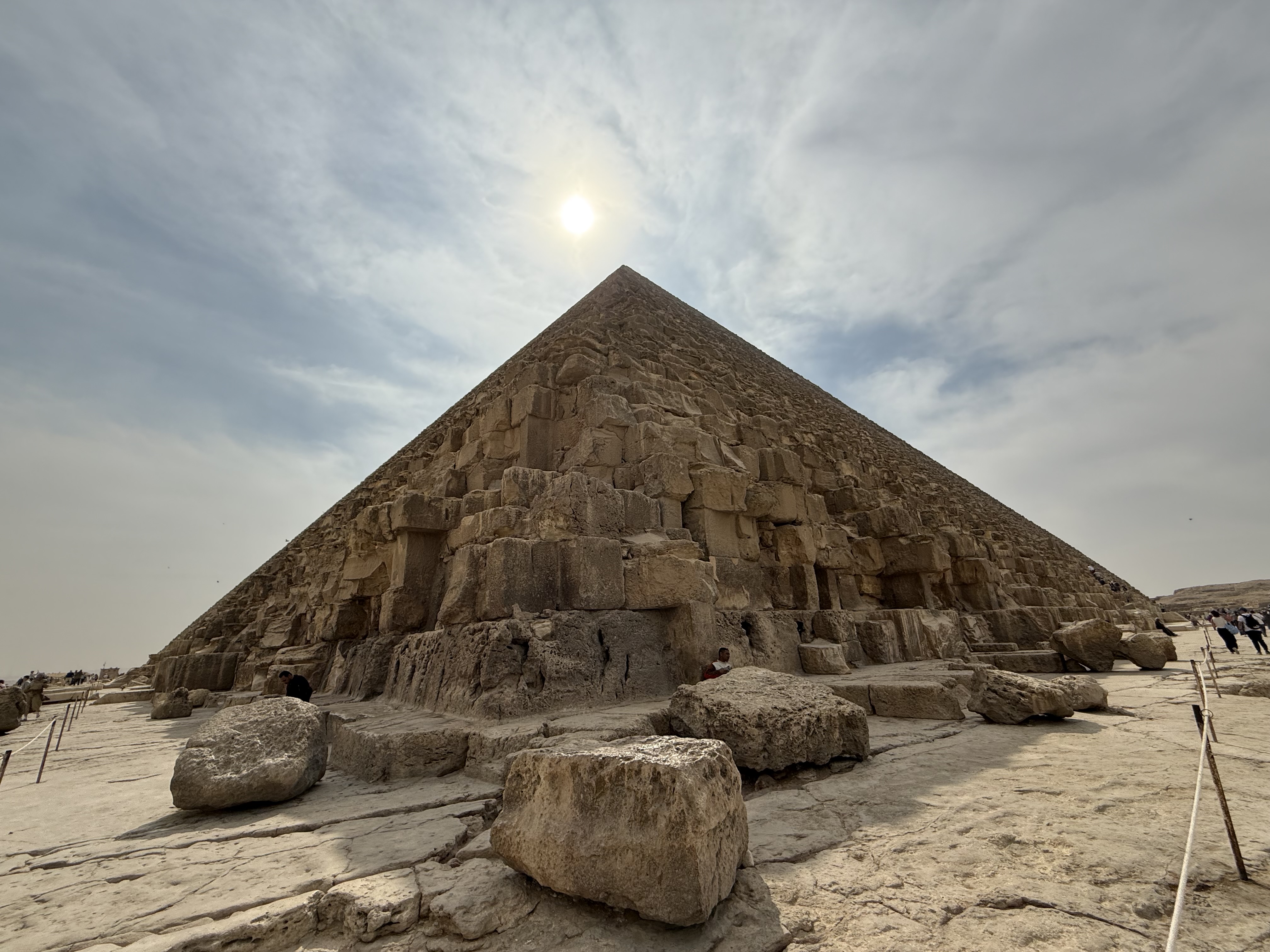
We stopped at the base of the Great Pyramid built by Khufu.  It is the largest and oldest of the great pyramids of the Giza site.  Oddly, there was a huge billowing black cloud of smoke billowing from a tree close by.  There was apparently some sort of fire that eventually got put out as we were at the site.  The smoke turned from nasty black to grey and white as they got that under control.  


It’s hard to imagine the scale of the great pyramids from pictures, but when you’re standing at the base looking up at it, it makes your head spin.  The sides are remarkably steep and it is hard to imagine how spectacular it was in its heyday when it was covered entirely with polished white limestone and topped with a gold covered cap stone.  Today, there are a few remaining limestone covering blocks around parts of the base, but most has been recycled over the millennia into other structures.  
There is more of the smooth limestone cap on the second largest pyramid.  Apparently, it got to be too dangerous and difficult to steal any more of it than what is already gone.  The third largest pyramid on site was supposed to be covered with granite, but was never finished.  There are granite blocks all around the base that had been intended for that project.  

The sizes of the pyramids got smaller as time went largely due to a declining economy and prosperity possibly related to an earlier climate change cycle.  Then as grave robbers found it too tempting to rob these pyramids, later pharaohs began to hid their burial sites in the Valley of the Kings, placing temples of worship in more public locations remote from the actual burial sites.  

We did not go into the Khufu pyramid, nor any of the others. Although our guides said they would accommodate anyone who wished to do so, they would have to pay the additional entrance fee and were forewarned that the descent into the great pyramid is much longer, steeper and difficult than the first tomb we entered and that there is nothing inside but an undecorated burial chamber with a plain undecorated stone sarcophagus.  And it would take at least a half hour to fight through the crowd descending and climbing back out of the narrow and steep passage.  Viking had wisely subjected us all to that first tomb, and there were no takers for entering the Khufu pyramid.  We did encounter some pretty aggressive local “Photographers” who insisted on helping tourists take pictures at the base of the pyramid, but who also insist on getting paid for their services. 

When you are standing at the base of the Khufu pyramid, it completely fills your field of view.  To get a better perspective, we drove a ways away to a hilltop where we could take a short camel ride and take pictures.  Viking had included the camel ride for those wishing to do it, but it was no more than about 15 minutes on camel back, several hundred yards and a chance for the camel handlers to take your iPhone and snap pictures, and then insist on a tip for the photography.  These camel guys were even more aggressive than those at the base of the pyramid.  


Our last stop was the Great Sphinx, which although it is a massive sculpture, it is not nearly as big as you might imagine it to be.  It is nothing like Mount Rushmore, for example.  But it may be more how the public can only view it from above, and are not allowed to wander around its base.  But we everyone can say they have seen the Sphinx’s tail without actually having been there.  It’s a little sad that the Great Sphinx’s beard is sitting in the British Museum virtually ignored, when it really belongs back on the Sphinx’s face.  Fatma has been pointing out things many niches where famous statues or carvings used to be, but which now reside in the museums or private collections in other countries around the world.


Dinner was provided by Viking at the hotel’s restaurant where we have been having breakfast, and it was also a buffet. This did include several local cuisine items like the Rokak phyllo dough with minced beef and Kofta kebabs.  They did have duck, turkey and chicken and fish options.  They also had quite a selection of desserts like we had at lunch.  Overall, the cuisine is bland but filling.  

We got our bags repacked except for all our charging equipment, AC adapters and toothbrush bag, which will go into the suitcase first thing in the morning.




Sunday, March 2, 2025

20250302 Cairo Citadel, Old Egyptian Museum and Khan el-Khalili Market

The Cairo Citadel, Egyptian Museum and Khan el-Khalili Market.

As seems typical of flying east across 10 time zones, we could barely keep our eyes open after 7pm and collapsed into bed after showers.  Then we found ourselves popping up out of bed wide awake at 3am, but forced ourselves to “rest our eyes” until at least 5am.  

The breakfast buffet at the hotel was what should be expected of a 4 star tourist hotel buffet.  In addition to the usual suspects, there were some regional items including a couple different sorts of dumplings filled with meats and cheeses.  


The welcome briefing mostly covered optional excursions and a sign up procedure for adding any excursions that we wished that we may not have signed up for in advance of boarding.  The only optional excursions that we had not booked that did not conflict with other optional excursions scheduled simultaneously were a visit to the new Grand Egyptian Museum, which is not officially open because it is only about half complete but accepting visitors, and a hot air balloon ride over the Valley of the Kings.  We had not originally signed up for the balloon ride but everyone who has done it has said it was the highlight of their trips.  Janet has always wanted to do a hot air balloon ride, so we decided to sign up for it, even though we will have to get up at 4am to do it.  Since we are already popping up at 3am because of our jet lag, that shouldn’t be too much of a problem.  

Today, we headed out in our tour coaches for the Salah ad-Din Citadel, which was a medieval fortification built to counter the invasion by the crusaders.  Within this Citadel are a few Mosques, including one called the Mohammad Ali Mosque. While the fortress dates back to the 10th century, this mosque was completed in the early 19th century.
Mohammad Ali Mosque


Ablution font in front of the Mosque entry


Giza pyramids visible in the distance from central Cairo.

The Citadel looks like a medieval fortification on the outside.  It had been used as a military outpost many times in its history.  Our tour took us pretty directly to the Mohammad Ali Mosque, which has a huge courtyard with a central ablution fountain which is now dry.  The interior of the Mosque is a grand open space for worshipping. Our guide Fatma said half jokingly that although the space is wide open and people may worship as they wish, men outnumber women 8:1 because while worshipping is mandatory for Muslim men, it is optional for women.  She also said that in more modern Mosques, it is now common for men and women to be segregated into separate areas. She thought that may be because a man seeing a woman’s rear end during prostration may have been too distracting, so women were largely relegated to worshipping at the very back of the space so that men would not see the women’s behinds.  It is notable that unlike in Christian churches, where images of Jesus and Mary abound, in Islam, the prophet Mohammad had specifically instructed his followers to never create images of him to prevent worshipping of a man versus worshipping his ideas.  So there are no depictions of any human forms, or even animal forms in the decor.  These are decorated mainly with geometric and abstract floral designs.  

"Old Egyptian Museum"


The next stop was the Egyptian Museum, which locals refer to as the Old Museum.  It contains anthropological collections from prehistory to the end of the rule of the Pharaohs.  There are many famous mummies in that museum that go on display on a rotating basis.  The mummy of the month while were were there was called the “Screaming Mummy” for the rather Edward Munchoid expression on this mummy’s face.  
The Screaming Mummy

This museum is most famous for being the repository for most of the Tutankhamen collection, which include his solid gold inner casket and burial mask.  However, these artifacts are slowly but steadily being transferred to the new Grand Egyptian Museum, so it’s uncertain how long King Tut’s riches will remain at the Egyptian Museum.  King Tut became famous for being the first Pharaoh’s burial which was intact when discovered by Howard Carter in 1922.  It had in fact been ransacked at some point, but the thieves had apparently been caught in the act and the tomb had been resealed with its contents disturbed but intact.  But his was not the only intact Pharaoh’s burial.  In 1945, the tomb of Psusennes I was discovered intact.  It, however, did not achieve the same fame as King Tut’s because the world happened to be caught up in WWII at the time.  Psusennes I also had artifacts on display at this museum which also included solid gold burial mask, jewelers and coffins.  

The King Tut exhibit was isolated to a single gallery which was patrolled by people constantly yelling “Keep Moving!  No Photography!”.  We had seen some of King Tut’s treasures when they were on a traveling tour in the 1980’s when we were working at the Pacific Science Center in Seattle.  But it was nice to see them closer to their native home.  
Tablet containing the oldest known Cartouches

Sculpture of Khafre

Only known likeness of Khufu

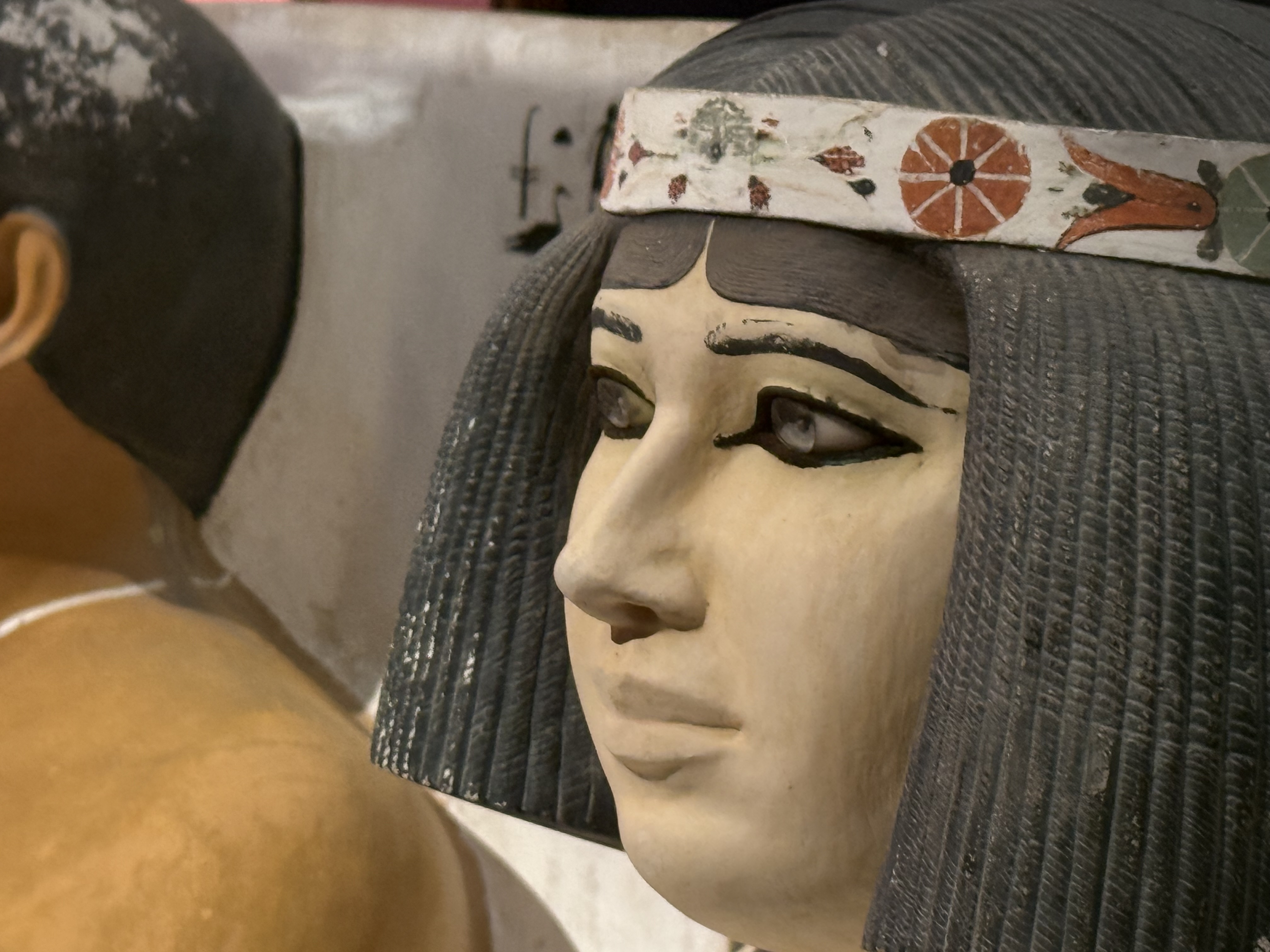
Lifelike eyes made of quartz.

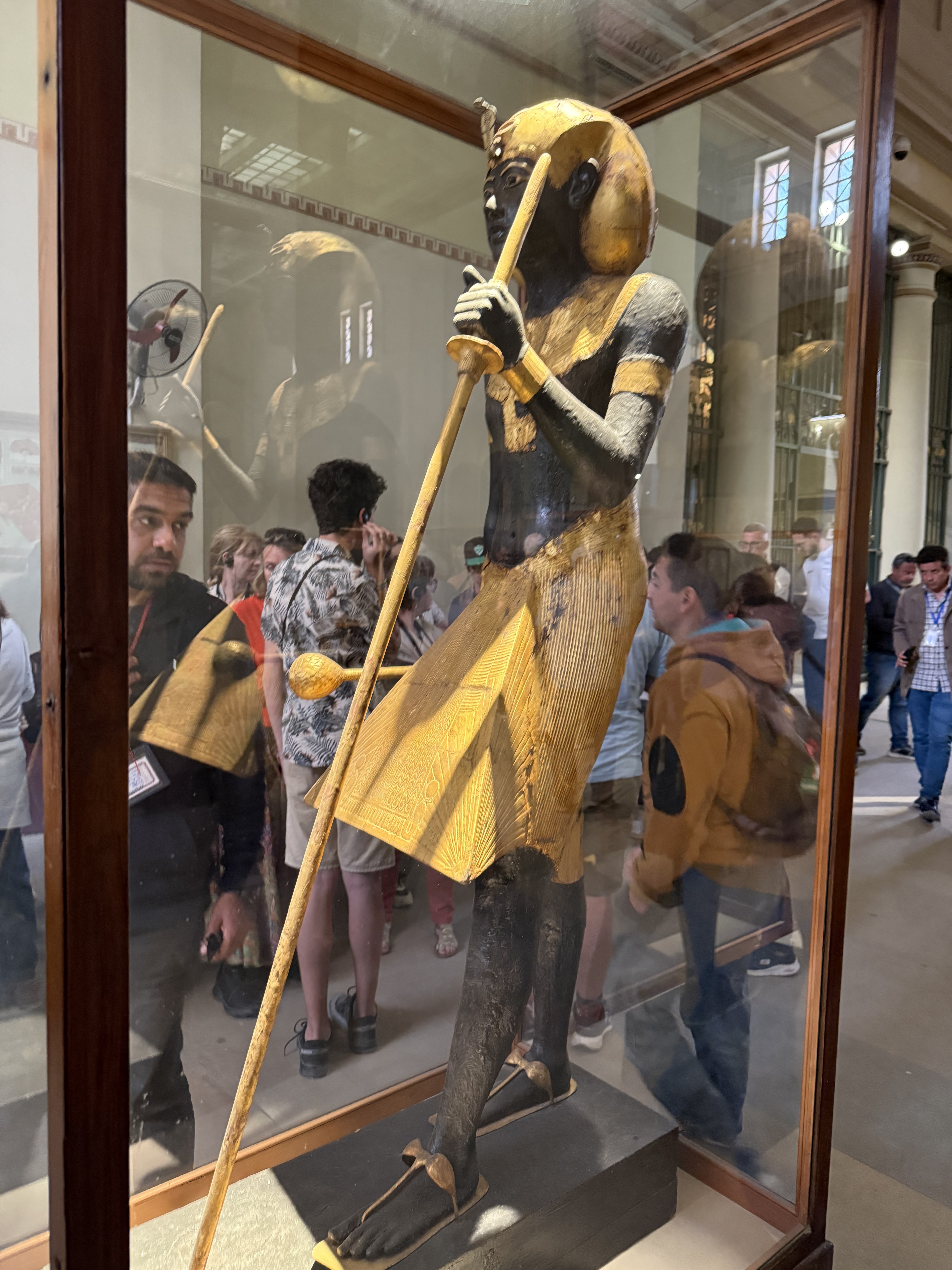
One of the guardians of Tutankhamen’s burial chamber

King Tut’s throne

King Tut’s canonic jars carved of alabaster

King Tut’s portable chair

We got back to the hotel a little after 1pm.  We were scheduled to go out on an optional excursion to see the National Museum of Egyptian Civilization, which is a museum that showcases Egyptian Civilization spanning from Prehistory to the present.  This excursion had to leave the hotel at 2:15, so there was very little time to find something to eat.  Ben had tried to see if he could find a sandwich in the hotel’s coffee shop, but they had sold out.  So we just took a short nap, figuring we could easily survive off the calories we had consumed at the breakfast buffet, but we had kicked ourselves for not having packed up some extra bread, cheese and cold cuts from the breakfast buffet to have for lunch.  

We hopped back onto the bus at 2:15, but the bus ran into insane traffic.  We crawled along the Nile past the US and British Embassies, but because the traffic was so bad, there was no way we were going to arrive at the museum with any more than a half hour before closing, so they cancelled the excursion (with automatic refunds) and turned the bus back to the hotel.  We took naps so that we’ll hopefully have the energy to not fall asleep during the evening’s Khan el-Khalili Market and Dinner program.  

The contrast between the traffic we encountered at 2:30pm and at 6pm could not have been more drastic.  People were at home with their families and friends breaking their Ramadan fasting so the traffic was light.  It was almost light enough for someone to cross the street between the hotel and the Nile river promenade, if they ran fast and were good at playing Frogger in the 80’s.  We did discover that there is a pedestrian overpass about a half mile upriver from the hotel that would allow for a safe crossing if you could get to that overpass by crossing a couple of side streets without getting hit.  

Cairo’s Khan el-Khalili Market is a maze of narrow streets lined by shops and Mosques.  There was a remarkable crescent moon tonight that looked just like the crescent moons that fly over the Mosque minarets.  


We were glad our guides knew where they 
were going through the maze.


We have been treated to ideal weather with daytime highs in the mid to lower 70’s and lows in the mid 50’s.  We both wore light fleece coats tonight and were quite comfortable.  You really do have to watch each step you take in Cairo, just Iike in Mexico because even sidewalks and pavement are littered with sink holes, drop-offs and irregular surfaces.  

The dinner tonight was at the Zeeyara restaurant in the market.  We had to walk up to the rooftop level, which we thought might be 3 floors, but it was actually 5.  There was comfortable seating and we could use the toilets for free, at least initially. 


Dinner started with hummus and a second dip that was creamier in texture but quite bland in taste, served with pita bread and some pickled eggplant.  There was then some minced beef in a flakey phyllo dough like an Egyptian spanakopita.  The beef was also quite bland in flavor.  The second course was a hot tomato soup which had a nice bit of tanginess from good tomatoes. There was also a fava bean falafel. 


The mains then came out with an okra vegetarian tagine and a beef and onion tagine.  A tagine is a clay or ceramic covered pot that these dishes are cooked in.  These were served with a sticky white rice.  The beef was cubed and somewhat dry with just a hint of anise flavor but both of the tagine dishes had flavorful gravies. Dessert was a large serving of rice pudding with golden raisins.   

Overall, the food was decent quality but for our tastes, rather bland and unimaginative.  However, concessions had to be made for sensitive western tourists GI tracts so there were no fresh vegetables or herbs which could carry GI bugs.  Randa, our guide for the evening, had her meal with vegetable salad which looked tasty, but which would have potentially caused the Pharaoh’s revenge in her western guests’ GI tracts.  

After dinner, we headed back to the bus with some free time to haggle with some of the more reputable vendors along the main passageway.  Our Viking handlers did an excellent job of helping us deal with these vendor gauntlets in several ways. The first thing was they advised us in advance to let them know if there were any purchases anyone had in mind so they could give us local advice on what reasonable prices would be for those items and what a reasonable range for haggling would be.  Next, they advised NO EYE CONTACT with any of the more aggressive vendors, who typically shove items at you or make you step around them.  They say once you have made eye contact and said NO, that means you have just begun negotiations with them.  On our way into the market before dinner, we were advised to keep an eye out for shops containing items of interest as we headed to the restaurant, but also told us to stay in single file, and continue to march straight through as a group lead by the Guide with the Viking Lollipop sign at the lead and our tall dark and handsome security guy at the tail.  This signals to the vendors don’t mess with this group or you’ll have to deal with tall dark and handsome becoming big, intimidating and likely to make your day more difficult than it needs to be.  Both the Guide and our security detail were quite efficient in dispatching with vendors who crossed the line.  You could tell as we streamed by that the potential troublemakers were trying to mark their easy targets as we streamed by, but knew better than to engage at this point as we streamed by.  

After dinner was the designated shopping time.  Here the strategy changed to accommodate shoppers.  A direct path was laid out for those not interested in shopping so they could take an express back to the bus. Those who wanted to shop were advised to try to stay outside of the shops where the guides could then keep an eye out for us and come to our assistance if we needed any assistance in negotiating or completing any purchases.  

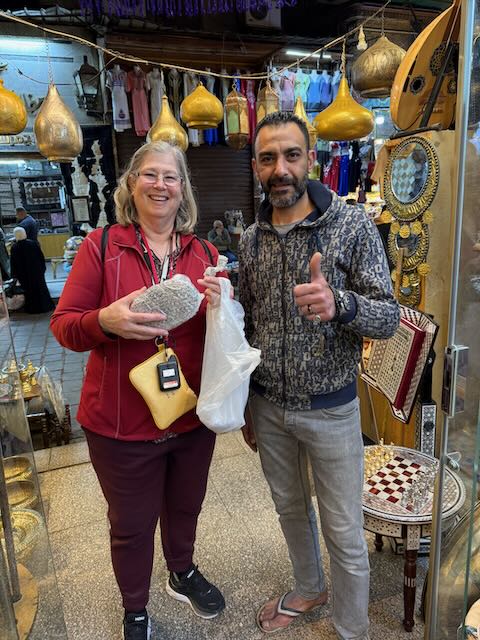
Janet did get sucked into a store but thanks to the advice given earlier, she already had an idea of what she wanted and how much she should expect to pay for it. She did manage to buy two of the mother of pearl jewelry boxes she was hoping to buy.  The shop keeper assured Janet they were real mother of pearl and not plastic by holding a lighter flame up to them.  He said plastic would melt and smell bad, but all we could appreciate was that they smelled like lighter fluid.  She got $64 haggled down to $53 with a modicum of effort.  The gift shop at the Egyptian Museum earlier in the day was selling similar but smaller items for a higher price.  The vendor took both of the boxes back to wrap them, but unless he was really good at sleight of hand, it appeared that the boxes Janet had bought were the same ones he wrapped tightly in bubble wrap and about 10 wraps of packaging tape.  I guess we won’t know with absolute certainty until we unwrap them at home.

Janet's triumphant 17% off purchase

Our handlers then swept the shops to get us all back on the bus. By then our batteries were running on empty.  Ben fell asleep on the bus heading back to the hotel at 9pm.  Tomorrow we head off to see the Sakkara step Pyramid, Giza and the Sphinx, so that will be another full day.  They let slip at the briefing this morning that camel rides will be a surprise inclusion, although we will have to tip the camel handlers.  

Saturday, March 1, 2025

20250228 Friday, February 28, 2025 to Saturday March 1, 2025. Heading to Egypt

20250228 Friday, February 28, 2025 to Saturday March 1, 2025. Heading to Egypt 


After we had to cancel our Viking Mekong Delta cruise last year because we wouldn’t have had time to get the very expensive tourist visa, we booked the Viking Nile Pharaohs and Pyramids cruise.  They had just launched the first of two new Nile River cruise ships, the Osiris, but had just opened bookings for the second ship, the Hathor.  Much to our surprise, there was only a single stateroom left on the ship that hadn’t been booked.  Sailings were already selling out leading into 2026, so we booked that last stateroom because it was during the ideal time for sailing when the temperatures are moderate and dry.  This will be a waterline stateroom without a veranda, but it will have a window and there are plenty of comfortable public spaces above to hang out in.  


It seems like a lot of people we know have recently been to Egypt.  Janet’s brother and his wife were there just last year, and one of Ben’s brothers also went last year.  We actually have some framed papyrus art that Janet’s father had purchased when he had been to Egypt many decades ago.  So it’s time we checked it out for ourselves.

Just 2 days before departure, we got a panic stricken call from our travel agent who had Norma from Viking Air on the line.  Our flights had originally been scheduled from SEA to Washington DC, Munich, and then Cairo.  Unfortunately, a labor strike in Munich cancelled our flight.  Lufthansa had defaulted to place us on a different flight the following day, which would have meant missing out on our first day in Cairo.  Norma was able to find an alternative that would get us to Cairo on time, but it would require a two connection flight- Seattle, Denver, Frankfurt, Cairo.  Not wanting to miss out on the Cairo tour, we said YES.  However, that also meant that our departure out of SEA would be at 8:50am instead of 2:30pm.  Out shuttle service to the airport unfortunately doesn’t run hourly, so in order to catch an 8:50am flight, we have to catch a 2am shuttle, which arrives at 4:30am.  The next shuttle which leaves at 4am would get us in 7:15am, which is cutting it a bit too close for getting through security during the morning rush hour.  

Fortunately, since we are flying business class, we have access to the United lounge, so we had a relaxing early breakfast instead of slumping on the seats at the gate for several hours.  Although their rules officially say no laying on or putting your feet on the furniture, the lounge was not very crowded and we found a quiet spot near the back where Janet could stretch out on a bench and catch a few zzz’s.  The lounge has a full complement of beverages including apple, pink grapefruit and orange juices, automatic espresso drink machines, teas and soft drinks.  The bar was closed until 10am so really hard core alcoholics will have to toughen up a bit.  The breakfast service was pretty decent, offering toast, Danish, cinnamon buns, croissant and English muffin breakfast sandwiches, cereal, oat meal, fruit and berry salads, yogurt and granola.  Since we had been on the road since 2am, we did appreciate having some early breakfast.

United Continental SEA lounge

The flight from Seattle to Denver was only 2-1/2hrs.  Business class domestic on the A320neo featured seats that recline by rocking the back and bottom forward as a unit.  This causes the video display on the seat backs to also drop dramatically, but they do pivot out at the bottom so you can still see the screen after the seat in front of you reclines.  

The Denver airport seems thoroughly modernized, but the gates are laid out in very long linear rows that stretch out a great distance.  There are moving walkways to help cover the distances, and people mover trains that move people between the terminals.  There is a United lounge in the A terminal and main terminal.  We arrived at the main terminal and had to take the people mover over to the A terminal, but since we had a 3-1/2hr layover, there was no problem once we figured out the layout.  We had lunch at the United lounge in the A terminal and then boarded our Denver to Frankfurt flight later in the afternoon.  

The Denver to Frankfurt flight was a 787 Dreamliner, and the business class seats are individual fully reclining pods.  These allow for more restful sleep, although with all the noise and other distractions, it’s still hard to get a decent night’s rest.  Ben ended up watching Gladiator 2, and then sleeping for several hours before the breakfast service stirred things up in the cabin.


We got into Frankfurt airport on time, which was comforting because we only had a 90 minute layover there.  We also did not have to clear customs or security since our bags were checked all the way through to Cairo, and United Airlines had issued us boarding passes for the Lufthansa flight to Cairo.  Stepping off the plane in Frankfurt was also like stepping back in time to the 1970’s because the jetways don’t align properly with the thresholds of the planes.  This resulted in an 8” step down that Janet nearly tripped over.  Then the jet ways lead to a series of stairs.  It would have been extremely difficult to get someone who was wheelchair dependent onto and back off planes there.  Our boarding gate was also just a bus stop where we boarded a bus which then took us out onto the tarmac amongst taxing jets, luggage handling equipment, fuel trucks and all sorts of other traffic.  It seemed so potentially hazardous.  Ben wondered how often an inadvertent jet blast might send a piece of equipment or personnel tumbling across the tarmac.


Sharing the road with jets

Ben was quite surprised that the flight got off to a late start.  So much for German efficiency.  Apparently, someone decided not to board the plane, even though their luggage had been loaded onto the plane.  This meant they had to take all the luggage out of the plane’s cargo hold, find that person’s bags, pull them out and then reload all the bags.  

Hmm, where is that bag?

Business class on this Lufthansa was simply not booking a third passenger in the middle of each of the first 10 rows of the plane.  We did have nice meal and beverage services though. Ben got introduced to a unique liquor called Ziegler Avionic, something made specifically for Lufthansa.  It is a sweet, fruity and herbal digestif which when mixed with bitter lemon makes a very refreshing and interesting cocktail.  


We arrived just a little late in Cairo.  As we approached Cairo, it was astounding how green and lush the Nile Delta looks like from the air.  Ben had imagined nothing but desert.  As we got closer to Cairo, we got a glimpse of the Great Pyramids of Giza from about 3000’ as the plane made its final approach turn for the airport. 

First glimpse of the Pyramids from 3000'

Closer to the airport, things do look like a desert.  There is also a remarkable degree of urban sprawl in Cairo.  

Downtown Cairo

We were met coming off the plane headed towards immigration by a Viking representative, who helped passengers obtain their Egyptian visas if they didn’t  do the e-Visa online like we had.  Those who got their visas at the airport got fancy looking sticky stamps which got pasted into their passports.  We just got an ugly rubber stamp.  


The Viking passengers are pretty easy to pick out of a crowd by their demographics (well to do American recent retirees) and their red Viking luggage tags.  There were about 27 or so on our flight, and about half or more had been flying business class as we had.  There was one Chinese American couple from New Jersey.  Everyone else, myself excluded, was typical white American tourists.

We got loaded up into a nice new Viking tour coach, identical to the ones used n their European River cruise operations.  We were informed that Ramadan had just begun, so traffic could either be decent or terrible as people rushed home to celebrate with families.  The first Arabic phrase she taught us was “Ramadan Karim”, which literally translates to Ramadan generous, but means Happy Ramadan.  

It ended up taking just a half hour to get from the airport to the Sofitel Cairo Downtown Nile hotel where we would be staying.  Our program director (Egyptologist) introduced herself as Fatma AbdAlla, and she will be with us for the duration of the cruise.  There are 3 bus loads that will be on the Viking Hathor, and we were bus B.  The total number of passengers on this cruise will be 82 or 83.  The other two program directors were Manal Fathy and Randa Riad.  We will be getting the Vox box devices tomorrow to use on our tours so we will be able to hear her in crowded areas.

The sun was rapidly setting as we arrived at the hotel.  Our first night is on our own, although most people were pretty worn out from the flights and just looking forward to showers and a decent night’s sleep in a bed.  That’s certainly all we did. Fatima said there were many others that will be arriving after midnight tonight.  We imagine they will not be able to enjoy tomorrow’s tours nearly as much as us.

The hotel is very nice and the rooms are up to our high expectations for Viking accommodations.  We have a nice view of the Nile from a small balcony, and a very spacious room.  We unfortunately discovered later that the bedsheets have a faint odor of tobacco.  Someone in the Laundry must be sneaking smoke breaks in the sheet storage room.


We will set our alarm clocks to get us up for breakfast tomorrow which starts at 6:30am.  Our tour begins at 7:55am with a morning briefing before we board the buses and head out.